Please activate JavaScript in your browser to use all interface options.

-315xx70.png)


Igor Sechin Presented the Keynote Report at the SPIEF-2026 Energy Panel
06 June 2026-350x1000.jpg)
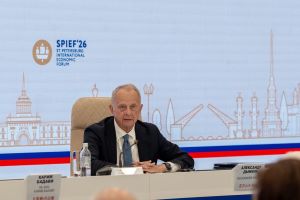
The Energy Panel was held within the framework of the XXIX St. Petersburg International Economic Forum. Executive Secretary of the Commission under the President of the Russian Federation for Strategic Development of the Fuel and Energy Sector and Environmental Security Igor Sechin presented the keynote report "The Beginning of the End or the End of the Beginning: What’s left at the Bottom of Pandora's Box?".
During the speech, a comprehensive analysis of the current situation in global energy markets and the global economy as a whole was presented, as well as a forecast for the development of the industry against the backdrop of growing systemic risks.
The moderator of the discussion, renowned American journalist and RT TV channel host Rick Sanchez, noted that Igor Sechin's speeches at SPIEF are invariably distinguished by the depth of expert assessments, the boldness of forecasts, uncompromising nature, and unwavering reliance on fundamental analysis. 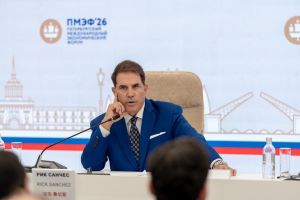 According to him, Igor Ivanovich's reports rightfully become the subject of the closest attention from the international industry community, leading mass media, and a wide range of professionals on both sides of the Atlantic.
PANDORA'S BOX IS OPENED
Opening the Energy Panel, Sechin drew a parallel between the development of the global economy and the ancient Greek myth of Pandora's box, which brought disasters and suffering to humanity. According to him, the so-called "rules-based order," where "rules" were dictated by an unquestionable hegemon, has completely collapsed. "An attempt is in evidence to replace the global legal system with the legal system of one country," stated Sechin, noting that such international institutions as the UN, WTO, IMF, and the World Bank have turned into "zombies." At the same time, new leaders have come to the forefront: now the global economy is an absolute hostage to political decisions that are made in the interests of large corporations - mainly technological, military, and financial. It is they who have formed a closed circle of beneficiaries.
"Along with such tools of influence as pandemics, disruption of supply chains, sanctions, embargoes, interference with internal affairs, political provocations, economic strangulation, hijacking of ships, blow-ups of pipelines, orchestration of coups d'état, etc., the use of armed forces has been added," told Sechin.
He stated: " Pandora's Box opened and the troubles and misfortunes that escaped from it will not go back. The key question is what problems are still left at the bottom of Pandora’s Box. What else do we have to face?".
According to Igor Ivanovich, the rapid growth of sanctions pressure causes particular concern. The speaker announced that over the past 12 years, 32 thousand sanctions have been introduced against Russia, with the leadership belonging to the US (more than 7,400 restrictions). Russian foreign exchange reserves worth over 300 billion dollars were effectively confiscated and are being used to finance military actions against our country.
 Sanctions pressure has become the norm and turned into an instrument of coercion. Sechin recalled how back in 2007 in his famous Munich speech, the President of Russia warned: "Independent legal norms are, as a matter of fact, coming increasingly closer to one state’s legal system. One state and, of course, first and foremost the United States, has overstepped its national borders in every way. This is visible in the economic, political, cultural and educational policies it imposes on other nations."
THE WORLD ON THE VERGE OF A FOOD CRISIS
Significant attention in the report was paid to the consequences of the conflict in the Middle East. The blockade of the Strait of Hormuz, in addition to oil and gas, created serious risks for the export of other goods, for example, fertilizers. In just the first four months of 2026, prices for fertilizers soared by almost 60%, which will inevitably lead to a jump in food prices in the next six months. The most vulnerable turned out to be India, the countries of Africa, and Southeast Asia.
Igor Sechin also warned that other "bottlenecks" of global logistics may also be under threat — the Straits of Malacca, Bab-el-Mandeb, and Gibraltar, the Suez and Panama canals. Under these conditions, the Arctic acquires special significance: the Northern Sea Route allows for reducing cargo delivery times by one and a half to two times and lowering costs by 20-30%.
GROWTH OF FICTITIOUS CAPITAL
The global economy has entered a zone not just of volatility, but of strategic risks. Problems are snowballing. The Head of Rosneft drew attention to the hypertrophied growth of fictitious capital, the volume of which exceeded 500 trillion dollars — almost five times more than global GDP. Global debt has effectively doubled over the past 15 years. According to the estimate of the International Monetary Fund, by the end of the current year, the total national debt of Japan will reach almost 205% of GDP, the US – almost 130%, France – 120%, the UK – 105%. This phenomenon has not bypassed our financial system either - in Russia, this indicator is already approaching 100% of GDP, noted Sechin.
The debt of most countries today is not backed by real financial assets, believes Igor Sechin. Even the physical gold located in US vaults (and this is more than 14 thousand tons) covers only five percent of the 39 trillion dollars of American debt. At the same time, a significant part of the gold stored in America does not belong to it – more than 40% of these reserves were transferred from other countries for safekeeping.
The situation is worsened by the use of the dollar as a sanctions instrument. Sechin believes that if this continues, the process of creating alternatives will accelerate. "The growth of the US government debt and budget deficit, the weakening of the dollar have already led to significant changes in the reserves of global central banks. For the first time since 1996, the share of gold in their reserves has approached 30%, exceeding the share of US Treasury bonds," he told. " I should note that the share of gold in the Bank of Russia's reserves is growing at an accelerated pace: over the past four years, it has increased from 21% to 45%. However, if this process had begun earlier, Russia would have been able to profit from the rise in gold prices by over $400 billion and would have preserved a significant portion of its reserves," emphasized Igor Sechin.
Due to sanctions, payment instruments are diversifying. "Over the past five years, the scope of transactions conducted through China's Cross-Border Interbank Payment System has more than tripled, reaching nearly one trillion yuan per day. The Hormuz crisis significantly accelerated this process," noted the speaker.
MILITARIZATION OF THE WORLD
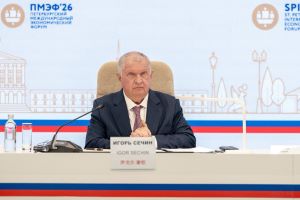 A separate place in the report Sechin devoted to the problem of the militarization of the world. According to him, global military spending has been continuously growing over the past 11 years. In Europe, Germany stands out, whose military spending over the past three years has doubled – to 114 billion dollars. He stated that Germany has begun transitioning its economy to a war footing.
"Berlin’s bid to host the 2036 Olympics became the peak of cynicism. Apparently, there is a desire to celebrate the centenary of the previous Berlin Olympics, conceived as a large-scale propaganda project to showcase the achievements of the Hitler regime," ironizes Igor Sechin. According to him, a simple chain has formed: political pressure leads to an increase in budget expenditures, which push up the market capitalization of a tightly intertwined triad: respectively, the military-industrial complex, high-tech corporations, and the financial sector. "It is this triad that draws a significant share of global investment resources," believes the speaker.
HIGH-TECH BUBBLE
Along with the military-industrial complex, the technology sector also attracts massive investments, told Sechin. This year alone, the four largest technology companies will direct about 700 billion towards the development of computing capacity.
"Today, artificial intelligence-related companies are actually consuming a significant portion of investment resources, to the detriment of the rest of the economy. The share of capital expenditures of the American tech sector in total investment has already reached a record 35%. Just 15 years ago, it was measured in a few percent," told Sechin.
" Clearly, the world is on the brink of the largest financial market bubble in history since the US railroad boom of the 19th century," stated Igor Sechin.
At the same time, the main generator and beneficiary of the approaching crisis is the financial sector of Western countries, which only yesterday was promoting a completely different - "green" - agenda: Blackrock, Vanguard, State Street. "The circle has closed," added Sechin. Significant growth in labor productivity is expected from artificial intelligence, but the numbers demonstrate a different situation. As Sechin told, about 70% of companies worldwide actively use artificial intelligence in their work. However, in 90% of cases over the past three years, the application of these technologies has had no effect on labor productivity.
He recalled that this phenomenon was described 40 years ago by Nobel laureate in economics Robert Solow. His statement reads, “you can see the computer age everywhere except in productivity statistics." The Solow paradox is that in the US in the seventies and eighties of the last century, labor productivity growth slowed by two percentage points, to 1%, despite a nearly 100-fold increase in computing power.
New technologies form a transition to a new socio-economic order - we are talking about fundamental changes in the development of the entire society, when robots replace people. "Demographics and a human being as a personality could lose their significance in the face of an army of machines if we just passively watch. We must clearly understand what kind of genie we're letting out of the lamp," warned Sechin.
He noted that religious authorities are already talking about the risks associated with artificial intelligence. In particular, it was exactly this topic that the first encyclical " Magnifica humanitas" by Pope Leo XIV was dedicated to, literally calling that "AI must serve humanity not concentrate power"
ENERGY TRANSITION AND RESOURCE DEFICIT
 Illusions of an accelerated energy transition have led to the underfunding of the industry: over the past 10 years, investments in fossil fuels have decreased by more than 20%. At the same time, a new energy market model "from molecules to electrons" is forming, the key element of which is data centers. According to forecasts, in the next five years, global demand for data center capacity could nearly triple — up to 220 gigawatts.
By 2035, global electricity demand will increase by almost 40%. Already today, data centers consume about 500 terawatt-hours per year, which exceeds the total electricity consumption of France. At the same time, the unbalanced development of "green" energy has led to an increase in electricity prices: in the US over the past 5 years — by more than 30%, in Europe — by 35-45%.
Power grids remain the key constraint: the need for their expansion and modernization will reach 60 million kilometers by 2035. Total investments in power grids in the next 25 years could amount to almost 16 trillion dollars.
Metals are also critically important for the development of a new type of energy system. Copper – the key metal of the "new" economy – is of particular importance. According to forecasts, copper consumption in power grids could grow by 65% by 2040 and exceed seven million tons, which is equal to a quarter of all consumption of this metal at the moment. At the same time, in the next 20 years, it will be necessary to mine a volume of copper comparable to production over the previous ten thousand years.
Access to water is becoming an additional constraint: in the US, a 100-megawatt data center requires about two million liters of water per day. "This is equal to the consumption of 6,500 households. By 2030 water consumption by data centers could nearly double," told Igor Sechin.
CHINA: AN EXAMPLE OF A BALANCED APPROACH
A separate place in the report was devoted to the experience of China. " In recent decades, China demonstrated not only economic success but also remarkable science and technology advances, enabling it to become a global energy power," stated Sechin.
Moreover, China turned out to be the most prepared for the Hormuz crisis and the rise in fuel prices - thanks to its balanced approach to ensuring energy security.
China has created cheap urban and intercity transport infrastructure for the domestic consumer. Sechin noted that after the blockade of the Strait of Hormuz, this allowed motor fuel consumers to painlessly use available alternatives, such as electric cars, electric buses, gas trucks, the subway, electric trains, and electric taxis.
In addition, China has a tangible competitive advantage in electricity prices: it is about 9 cents per kilowatt-hour for industry (72% lower than in Germany, and 59% lower than in France) and about 7 cents per kilowatt-hour for the population (58% lower than in the US). " Only Russia stands at a similar level," added Igor Sechin.
Over 10 years, solar and wind energy generation in China has grown 10 times — to 2,300 terawatt-hours (22% of the country's energy balance). At the same time, the country continues the construction of thermal power plants: last year alone, 78 gigawatts of coal generation were put into operation. China is also implementing the largest program for the development of nuclear generation: 39 reactors are being built — more than half of all nuclear power plants under construction in the world. Energy storage plays an important role in ensuring the flexibility of the energy system - China also leads in this sector. In parallel, China leads in investments in power grids, investing about 100 billion dollars in this sector.
INDIA AS A DRIVER OF DEMAND GROWTH
 In his report, Sechin also separately highlighted India. "Today, India's economy is one of the key drivers of global energy consumption growth. According to the International Energy Agency’s projections, over the next 10 years, this country will account for about 15% of the global increase in electricity demand. By 2035, consumption in India is expected to grow by 80% to nearly 3,000 terawatt-hours, making it nearly equal to that of the European Union," he told.
A special place, according to Sechin, is also occupied by India in the oil market: "over the next 10 years, the country will account for approximately half of global oil demand growth." According to the estimate of the International Energy Agency, by 2035 oil consumption in India will reach nearly eight million barrels per day. This is a growth of 44%, while global demand will grow by only 5%.
OPEC+: LOST POTENTIAL
Special attention in the report was paid to the situation in OPEC+, which, according to Igor Sechin's assessment, has undergone significant changes. With the exit of the United Arab Emirates, and prior to that Qatar, Ecuador, and Angola, " OPEC+ has lost part of its potential." Over the past ten years, OPEC+ production has decreased from 58 to 37 million barrels per day.
As the head of Rosneft noted, if we take into account that Iran, Venezuela, and Libya initially did not participate in the production restrictions, and Iraq and Kazakhstan significantly exceed the established quotas, then the production of the alliance member countries that comply with the restrictions actually amounts to 27 million barrels per day — less than a third of global production.
At the same time, Russia, having taken upon itself obligations to limit production, strictly fulfilled them and fully contributed to solving the alliance's tasks. However, the Russian oil industry has all this time been under sanctions that deprived the country of advantages that other participants received. As Igor Sechin emphasized, most major OPEC+ participants increased production during the period of the agreement. In Russia, however, over the period of restrictions, oil production decreased by 1.5 million barrels per day — a drop of 15%, which will have to be compensated for by necessary investments in the amount of at least 10 trillion rubles.
Particular concern, according to the speaker, is caused by the fact that, despite the support received by major participants in the alliance, their investment cooperation with Russia has not been developed.
RUSSIA — GUARANTOR OF GLOBAL ENERGY SECURITY
Igor Sechin emphasized that Russia cannot be excluded from global supply chains. Our country possesses the world's largest oil and gas reserves in the amount of about 60 billion tons of oil equivalent (14% of global reserves). Russian oil supplies bring a tangible economic effect to partners: since April 2022, its combined value for China and India has exceeded 40 billion dollars.
At the same time, the Russian oil and gas industry is affected not only by external restrictions but also by unfavorable macroeconomic conditions. The current level of interest rates leads to a significant increase in debt servicing costs, and the strengthening of the national currency, according to calculations by the Russian Academy of Sciences, led to losses of the federal budget of more than two trillion rubles last year alone.
WHAT’S LEFT AT THE BOTTOM OF PANDORA'S BOX?
 Concluding the report, Igor Sechin answered the key question of his speech: at the bottom of Pandora's box, humanity will inevitably discover a global shortage of electricity, a shortage of food, a shortage of copper and other metals, and a water shortage. It is these challenges that will determine the new face of the global economy.
" Those that are best prepared for this will survive. This will be, in essence, "the end of the beginning", when empty hopes, illusions and salvatory chimeras will disappear forever," noted the head of Rosneft. "The real end of the systemic crisis and the formation of a new normality are still very far away. Not everyone will see it come."
PRESENTATION TO THE REPORT OF I.I. SECHIN AT THE SPIEF ENERGY PANEL
Department of Information and Advertising
Rosneft Oil Company
June 6, 2026