Please activate JavaScript in your browser to use all interface options.

-315xx70.png)


Energy Panel Participants Discussed the Prospects for Oil Prices for the Coming Year
06 June 2026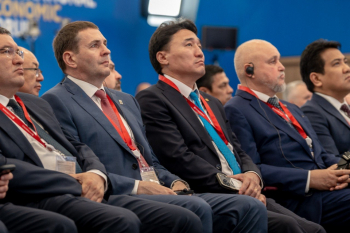
The Energy Panel, organized within the framework of SPIEF-2026, concluded with the traditional forecast of oil prices for the coming year from its participants. This year, the forecast was presented by Igor Sechin, Minister of Energy of the Republic of Uzbekistan Jurabek Mirzamahmudov, former head of the International Energy Agency (IEA) Nobuo Tanaka, and President of the TOFS Group of Companies David Gadzhimirzaev.
According to Sechin, the determining factor for the medium-term dynamics of the market is the current situation in the Strait of Hormuz. "If you tell me exactly how long the crisis in the Strait of Hormuz will last, then it will be easier for us to determine the level of impact of the dropout of 16 million barrels per day on the price," he stated.
In his opinion, "if the lifting of restrictions (associated with the conflict in the Strait of Hormuz - ed.) happens now, then, perhaps, by the end of the year the average price will reach the level of 95 and 96 dollars per barrel."
"It will take about six months to restore positive dynamics. And then in a year we will observe about 80-85 dollars per barrel. Because restoring supplies alone requires significant time and investments. Thus, by the second half of 2027, it will probably be possible to talk about a return to the fundamental indicators of the market. It seems to me this will be a more objective approach to pricing issues," said Igor Sechin.
At the same time, he also voiced expectations under another scenario of events – in case if new sanctions are yet again imposed on Russian oil. "If 7 million of Russian oil exports are added to the 16 million barrels of already restricted volume, then another 100 dollars will be added to the level of 150-160," stated Sechin.
However, the authors of the new sanctions proposals must understand, believes Igor Ivanovich, that out of the specified volume of 7 million barrels, Russia will nevertheless retain a significant part of the exports.
"And their plan is unlikely to be implemented the way they would like. The increased price level will compensate for the shortfall of sanctioned volumes. Therefore, one probably shouldn't step on a rake here, because it can cause you damage," said Sechin.
"There are a lot of risks. And given that political decisions are beginning to shape fundamental indicators - anything is possible. But we are ready for this. And I think that we will compensate for a significant part of those restrictions that may be introduced. At the same time, what will be the cost of petroleum products at gas stations in California? That also remains to be seen," he summarized, answering to the question.
In turn, the former head of the IEA and recognized energy expert Nobuo Tanaka believes that due to a lack of supply, the price of oil in the coming months will most likely be very high. "And I think that it could reach a historical level - more than 170 dollars per barrel, and even higher, before it starts to decline. This is a very, very serious situation. And I believe that Russia will become a very important player in the context of increasing supply," noted Mr. Tanaka.
Minister of Energy of Uzbekistan Jurabek Mirzamahmudov in his answer noted the necessity of forming a stable and predictable price. Answering the corresponding question, he did not rule out a return of quotes in the future to the level of 60 dollars per barrel. David Gadzhimirzaev also noted the difficulty in forecasting exact figures. According to him, the world's largest banks, based on the Middle East crisis, predict a variation from 78 to 90 dollars per barrel, and taking into account absence of various shocks, the forecast is 60–70 dollars. At the same time, he emphasized that the price should not fall below 60 dollars per barrel.
Department of Information and Advertising
Rosneft Oil Company
June 6, 2026