Please activate JavaScript in your browser to use all interface options.

-315xx70.png)


The Future of Global Energy Was Discussed at the SPIEF Energy Panel
06 June 2026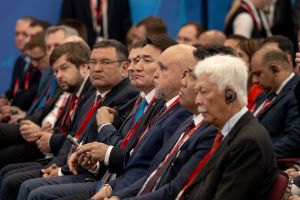
Leading industry experts, politicians, and heads of major international energy companies discussed the current challenges and prospects for the development of the global energy market at the Energy Panel of the XXIX St. Petersburg International Economic Forum.
The discussion took place after the keynote report by Igor Sechin, Executive Secretary of the Commission under the President of Russia for Strategic Development of the Fuel and Energy Sector and Environmental Security, titled "The Beginning of the End or the End of the Beginning: What’s left at the Bottom of Pandora's Box?".
The speakers highly appreciated the presented analysis: the report was called brilliant, deep, and uncompromising, and its informativeness and comprehensive nature were noted. The discussion participants repeatedly referred to the theses and facts presented in the report, using them as a basis for their own speeches and further discussion.
The event was attended by Ricardo Menéndez, Vice President for Planning of the Bolivarian Republic of Venezuela; Karim Badawi, Minister of Petroleum and Mineral Resources of the Arab Republic of Egypt; Jurabek Mirzamahmudov, Minister of Energy of the Republic of Uzbekistan; Nobuo Tanaka, longtime Head of the International Energy Agency; David Gadzhimirzaev, President of the TOFS Group of Companies; as well as representative delegations from China, India, and other countries.
ENERGY SECURITY REQUIRES COLLECTIVE ACTION
Speaking to the discussion participants, Ricardo Menéndez, Vice President for Planning of the Bolivarian Republic of Venezuela, stated that respect is of paramount importance for the development of the energy industry and the formation of balance in the world. He noted that Venezuela is facing not just sanctions, but serious aggression, which caused a dramatic drop in hydrocarbon production in the country and, as a consequence, a decrease in revenues
"From 56 billion in revenues from the oil industry, we went to 700. That is, we lost 99% of oil revenues. This places the country before a very difficult choice. We need to ensure the social protection of the population, maintain logistical links, and social services," emphasized Menéndez.
Venezuela, according to him, is developing a new plan for reforming the government structure based on democratic principles. "Technology, productive diversification, and sovereignty are the keys to the transformative processes that are currently taking place on the territory of our country," the Vice President added.
As noted in Igor Sechin's report, sanctions pressure in the world has become the norm, and trade barriers have ceased to be an exceptional measure. Over the past four years, the application of restrictions has grown manifold, and the volume of global commodity imports subject to various restrictions has reached almost three trillion dollars.
THE HORMUZ CRISIS IS A HISTORICAL SHOCK
Nobuo Tanaka, longtime Head of the International Energy Agency, called the blockade of the Strait of Hormuz the "fourth oil shock," the consequences of which are much more serious than all previous ones.
"2 billion barrels pass through there. Compensating for these volumes by releasing strategic reserves is simply impossible. These consequences are much higher than the previous oil shocks we have faced before. This is a historically large-scale shock," stated Tanaka.
He emphasized that no single country can achieve energy security alone—it must be of a collective nature. At the same time, according to the expert, all countries today are trying to diversify energy sources so as not to be limited to the Middle East.
"Many in Asia have now turned to Russian oil. Russia in this context is a very stable and reliable partner and supplier of energy resources," noted Tanaka, expressing hope that Russia and the IEA will play an important role in stabilizing the oil market.
In his report, Igor Sechin dwelled in detail on the consequences of the Hormuz crisis, noting that the blockade of the strait became an attempt to change the regulation of the global energy market in the interests of the US, but it hit the entire world. Western countries are experiencing a double price shock: electricity has been joined by the rising cost of motor fuel, prices for which in the US have grown by more than 50%, and in Europe—exceeded 20%.
NUCLEAR ENERGY AND REGIONAL COOPERATION
Minister of Energy of the Republic of Uzbekistan Jurabek Mirzamahmudov noted that Russia is a strategic partner of his country. Cooperation is carried out both in the field of supplying oil and gas raw materials and petroleum products, and in the field of personnel training—12 branches of leading Russian technical universities operate in Uzbekistan.
"You noted the development of nuclear energy for the long term. Being fifth in the world in uranium mining, it would be a sin (for Uzbekistan - ed.) not to use this resource," noted the Minister, addressing Igor Sechin. He added that coal will also remain part of the country's energy balance, however, it will replace old blocks with more modern and environmentally friendly ones.
Special attention, according to Mirzamahmudov, must be paid to the development of power grids. "Absolutely, without them the integration of renewable energy and capacity balancing is impossible," he emphasized, also noting the importance of regional interaction within the framework of the unified energy ring of Central Asia.
Igor Sechin emphasized in his report that power grids and energy storage remain the key constraint on the development of the energy system. The need to expand and modernize networks will reach 60 million kilometers by 2035, and total investments in power grids in the next 25 years could amount to almost 16 trillion dollars.
EGYPT AS A REGIONAL HUB
Minister of Petroleum and Mineral Resources of the Arab Republic of Egypt Karim Badawi thanked Igor Sechin for the invitation to the Energy Panel and noted the strong partnership relations between Egypt and Russia, which have lasted for many decades.
"Egypt today is not going to compete with Russia in terms of gas production volume. However, Egypt would like to concentrate its efforts on acting as a regional hub <...> to extract the maximum effect from Egypt's geographical location," stated Badawi.
He emphasized that Egypt strives for a balance between the use of natural gas and renewable energy sources, which should provide about 42% in the country's energy mix by 2030. "Egypt understands that it cannot cope alone, because the requirements in the field of energy are extremely large. We need to establish partnerships with other countries, the private sector, and technology companies," the Minister summarized.
In his report, Igor Sechin noted that the Hormuz crisis created risks not only for the oil and gas market, but also for the global food complex. Supply disruptions of fertilizers, a significant volume of whose exports passes through the strait, increase the risk of a global food crisis. Prices for fertilizers soared by almost 60% in the first four months of the year, which will inevitably lead to a jump in food prices.
TECHNOLOGICAL SOVEREIGNTY AND INVESTMENTS
President of the TOFS Group of Companies David Gadzhimirzaev, speaking at the panel, noted that Russia is successfully responding to current challenges in drilling and production.
"In Russia, 90% of all oilfield service producing companies are domestic. In the world—only 20% are local companies. If we compare 2022 and 2025 in terms of technology localization, in 2022 localization was 35%. To date, localization exceeds 70%," stated Gadzhimirzaev.
He emphasized that compared to last year, the level of production drilling fell by 3%, but horizontal drilling grew by 4%. "This suggests that the country has learned to drill complex wells, extended wells, and for this we have all the technologies in our country," he emphasized.
Speaking about long-term investments in R&D, Gadzhimirzaev noted a chronic shortage of funds in this area. "This is a very complex element that requires support not only from the oilfield service, science, and the subsoil user, but also huge support from the state," he said.
Igor Sechin in his report also drew attention to the problem of underfunding of the industry. Over the past 10 years, investments in fossil fuels have decreased by more than 20%, with the bulk of the drop falling on the oil sector, where capital expenditures fell by 35%. This decline is part of a broader trend of reducing investments in industrial production.
The topic of the lack of funding was covered in detail in Igor Sechin's report. He noted that the Russian oil and gas industry is negatively affected not only by external restrictions but also by unfavorable macroeconomic conditions: the current level of interest rates leads to a significant increase in debt servicing costs, worsening the financial stability of companies; the inexplicable mechanism of forming the ruble exchange rate reduces the revenues of exporters and the federal budget—according to calculations by the Russian Academy of Sciences, budget losses from the strengthening of the national currency last year alone exceeded 2 trillion rubles; in addition, pressure on the industry is exerted by the growth of natural monopoly tariffs outstripping inflation.
Department of Information and Advertising
Rosneft Oil Company
June 6, 2026